Can Inter Miami Achieve Their Super-Club Dreams While Messi Pulls the Strings?
August 28, 2026
WORDS
Adam Booker
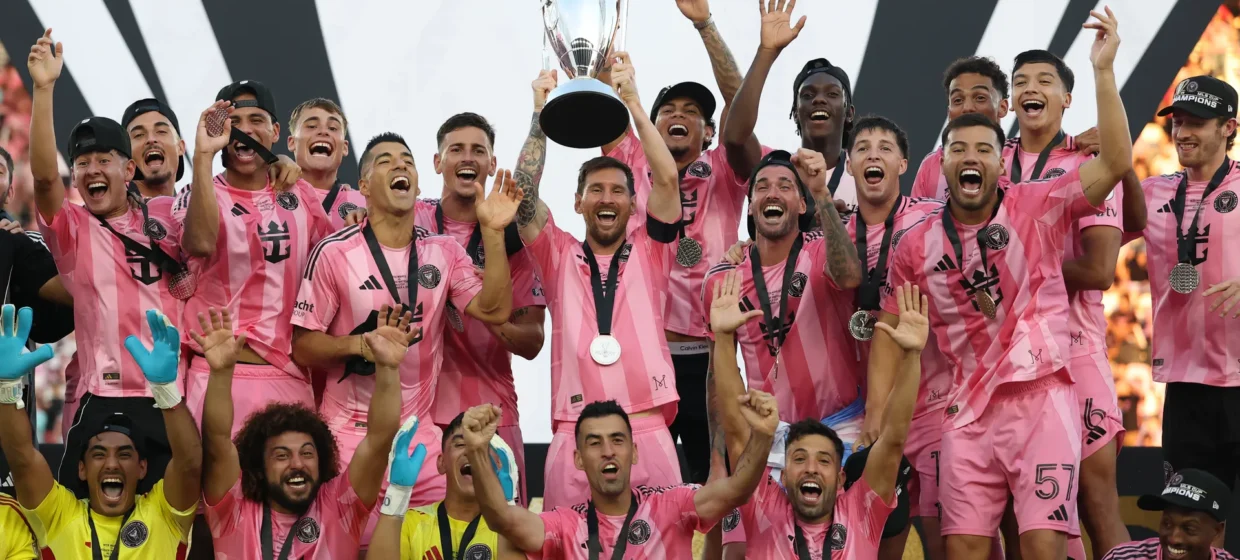
Back in December 2025, Inter Miami finally secured their first MLS Cup. Lionel Messi delivered two second-half assists in a 3-1 win over the Vancouver Whitecaps, sending Sergio Busquets and Jordi Alba into retirement as champions and handing the Herons the first league title in club history. It was the exact kind of moment David Beckham and Jorge Mas envisioned when they lured Messi to South Florida in 2023.
And yet the question hanging over the club hasn’t gone away. If anything, it’s gotten louder. Can a team built almost entirely around one aging genius and his circle of friends from European football ever really turn into the “superb club” that they want to become? The kind of institution that outlasts any one player, rather than a vehicle for a superstar’s victory lap?
There’s no debating what Messi brings on the field. He set a single-postseason MLS record with 15 goal contributions in the 2025 playoffs, tallied 43 goals and 28 assists across 49 appearances on the year, and was named MLS Cup MVP for good measure. No club in the league’s history has ever had access to that level of individual output.
But that individual brilliance has come with a tradeoff, and it’s shaped everything about how Inter Miami are built. The squad hasn’t been assembled as a balanced, self-sufficient unit designed to win with or without any one player. It’s been assembled around Messi, his aging friends that have come to town with him, and a supporting cast whose job is largely to feed him the ball and cover the space he leaves behind. That’s a roster built for chemistry with one man, not for balance across a full squad. It shows in exactly the moments when Messi isn’t enough to paper over the gaps, like the shocking first-round playoff exit to a ninth-seeded Atlanta United side in 2024, a loss that came right after Miami had just set the all-time MLS points record.
If you want to see how much the entire project revolves around Messi, look no further than how Inter Miami hire their head coaches. When Tata Martino stepped down after that 2024 playoff collapse, owner Jorge Mas was refreshingly candid about what the club were actually looking for in a replacement. Experience in MLS wasn’t the priority. What mattered was finding someone who could “manage the roster,” a roster stacked with aging global superstars who each carry outsized influence in the locker room. Mas even said he consulted Messi directly before the final decision was made.
The result was Javier Mascherano, a decorated former teammate of Messi, Busquets, Alba, and Suárez at Barcelona, but a man with zero senior club coaching experience anywhere in the world before taking the job. It’s hard to look at that hire and conclude the primary qualification was tactical acumen or the ability to manage a diverse 26-man roster. The primary qualification was that Messi already knew and trusted him. While Mascherano did lead Miami to the coveted MLS Cup triumph, he departed quickly in the following season after a wretched run to start the campaign.
Just this week, the club brought in ‘Kily’ González, another relatively inexperienced coach without a history of winning trophies. González’s connection to Inter Miami? He grew up in the same town as Lionel Messi, and was his teammate in the Argentina squad back in 2006.
Now we have a clear pattern: the club will ignore much better coaching candidates to ensure they avoid any friction with their superstar in the dressing room. It’s organizational philosophy in which the head coach’s job in Miami isn’t to build the best possible team, it’s to keep the dressing room’s biggest star comfortable.
This is where the more interesting question comes in. Inter Miami have the financial resources, the media pull, the stadium project, and the cultural cachet to sit at the table with North America’s biggest clubs. If ownership pointed even half of that machinery toward building a deep, age-balanced, tactically coherent squad, rather than stacking the roster with Messi’s old friends and hiring coaches who won’t rock the boat, would the results actually be better?
It’s a fair bet they would. A club with Miami’s resources could be recruiting rising South American and European talent in their early-to-mid twenties, building a real academy pipeline, and hiring a coach for his tactical identity rather than his personal relationship with the captain. Instead, the current approach treats each new marquee signing as another spoke in the Messi wheel. Rodrigo De Paul arrived on loan specifically to play alongside his national team captain, and the likes of Mascherano and González were hired specifically because they wouldn’t create locker-room friction. Those are short-term decisions optimized for keeping one 38-year-old happy for the two or three years he has left, not long-term decisions optimized for what the club looks like in 2030.
None of that means Miami’s current approach is irrational, by any means. Messi is a generational commercial engine, and every ticket or kit sold, and Apple TV subscription driven by his presence funds the very ambitions that could someday build something more durable. But there’s a growing tension between exploiting a superstar for short-term revenue and prestige, and building the kind of institutionally sound club that outlasts him.
A “superb club,” in the way that phrase gets used about the great institutions of world football, implies durability: a footballing identity, a pipeline of talent, and a capacity to win consistently that isn’t contingent on any single player’s health, form, or mood. Inter Miami, as currently constructed, don’t have that. They have an extraordinary two-and-a-half-year run of memorable nights, an MLS Cup finally in the trophy case, and a roster and coaching staff whose organizing principle is keeping Lionel Messi and his old friends comfortable.
That’s an entirely reasonable strategy for a club still establishing itself in a growing league, and it’s produced real silverware. But it’s a superstar-vehicle strategy, not a superclub strategy. In the coming years we will see the real test of whether Inter Miami will become something more than “the club Messi plays for.” It begs the question whether the infrastructure, coaching philosophy, and recruiting approach built in his shadow can actually stand on their own once the shadow is gone. Until then, considering Inter Miami as anything more than an expensive flash in the pan is jumping the gun.
