The Questions Surrounding Mauricio Pochettino’s Extension With The USMNT
August 7, 2026
WORDS
Adam Booker
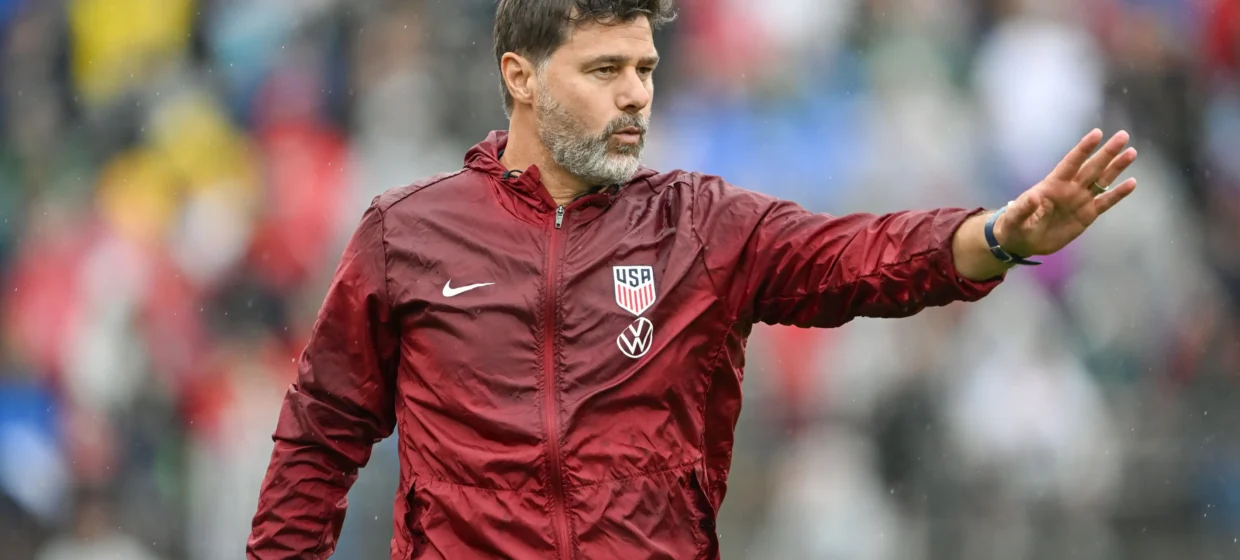
This past week, U.S. Soccer made Mauricio Pochettino’s contract extension official, keeping him as USMNT head coach through the 2030 World Cup. It’s a bit of a surprising outcome, honestly. Pochettino just led the U.S. to its best World Cup showing since 2002, and instead of using that as a launching pad back to one of Europe’s giants, given a résumé that includes Tottenham, PSG, and Chelsea, he appears to have chosen to keep building something that’s still very much unfinished.
“Working together with U.S. Soccer over the past two years, it has become clear to us that there is tremendous potential to make the Men’s National Team program even stronger,” said Pochettino in a federation statement. “The passion we experienced from the fans throughout the World Cup only strengthened our belief in what is possible here. We are excited by the opportunity to bring all our experience and knowledge to even more areas of U.S. Soccer while helping strengthen the pathways for players, coaches and teams across the Federation. We want to try to have a lasting impact on the sport in the country that has welcomed us so warmly and for that impact to extend beyond results on the field.”
The deal runs four more years, is reportedly financially backed in part by Citadel founder Ken Griffin, and includes “mutual protection” clauses in case things don’t work out before it’s up. But signing the extension doesn’t really settle the debate around Pochettino’s future. If anything, it just gives the debate a new shape. Here are the questions still worth asking.
First foremost, there is the pull of big openings at elite European clubs. When some of the world’s top jobs become available and Pochettino is inevitably on their shortlist, will he be able to say no? That is the question that just won’t go away. For most of the past two years, Pochettino’s name has kept popping up alongside Europe’s elite clubs.
Real Madrid reportedly saw him as a serious option during their coaching uncertainty at the Santiago Bernabéu. Manchester United and Tottenham had both kept him on their radar before going different directions. AC Milan even sat down with him in person back in May. Pochettino himself has never really shut the door on any of it either. “You can never say never,” he likes to say, and he’s admitted more than once that he misses English football specifically. London has reportedly always been ‘home’ for the Argentine. At least a few of those jobs will almost certainly be open once more this time next year.
The federation’s answer to all that speculation seems to be baked right into the contract. The “mutual protection” language suggests both sides know this relationship might not actually make it to 2030, and they’d rather build in an exit plan than pretend that risk doesn’t exist. That’s a sensible way to hedge your bet, but it’s not the same as loyalty. If Real Madrid or a Premier League powerhouse comes calling at the right moment, say 18 months from now if some struggling superclub fires its manager, it’s worth asking whether even a well-funded national team job can really compete with the pull of the Champions League and a squad full of superstars.
Set the “will he leave” question aside for a second. Is this even the right bet for U.S. Soccer to make? The federation is putting serious money behind Pochettino, with outside backing from Griffin among others, for a term that isn’t guaranteed to actually play out. If he leaves in two years for a job in Europe, the U.S. is right back in the position it’s been stuck in for over a decade: swapping coaches in the middle of a World Cup cycle, the same pattern that undid both Jurgen Klinsmann and Gregg Berhalter.
But there’s a fair counterargument here too. Not extending Pochettino guaranteed instability starting immediately, while extending him only risks it down the road. Given how badly past coaching changes have gone for this program, a coach who might leave in three years still looks like a better bet than starting a fresh search today. It also matters that the extension keeps his entire staff intact, including longtime assistants who’ve been with him for years. Even if Pochettino himself doesn’t finish the deal, that continuity has real value. The USMNT will almost certainly participate in the 2028 Copa America, another chance for Pochettino to make history in American soccer with success at a truly major international tournament.
Back at the 2026 World Cup, however, the U.S. won its group and got through to the knockout rounds before losing 4-1 to Belgium in the Round of 16, the program’s best finish since it reached the quarterfinals back in 2002. On paper, that’s progress, but the reaction inside U.S. soccer has been pretty split. Some see real growth, while others think it was just another disappointing finish dressed up as improvement, especially with a golden generation that was supposed to break through on home soil. Critics have pointed out that the underlying performances haven’t really improved much since Pochettino took over, even if the scoreline looks a little better than past tournaments.
That split matters when you’re trying to judge whether the extension is deserved. Pochettino inherited the job less than two years before the tournament and never got a real qualifying campaign to work with, which is about as tough a starting position as a coach can have. This next cycle gives him four full years, actual competitive qualifiers, and time to shape the roster from the ground up. That’s a very different job than the one he just did. Whether the extra time actually leads to a deeper run in 2030 is the bet U.S. Soccer is making right now, mostly on faith.
A lot of the hesitation around this extension isn’t really about the coach at all. It’s about timing. Christian Pulisic, Weston McKennie, and the rest of that so-called golden generation were supposed to peak at a World Cup on home soil, and by most accounts, this was close to the best that group was ever going to look. Over the next four years, Pochettino has to manage that core transitioning into something new, while bringing in a younger wave of players. He’s already given first caps to guys like Alex Freeman and Matt Freese, so there’s evidence he can do it. Still, it’s a genuinely hard rebuild, and it’s fair to wonder whether the coach who got the most out of a talented, established group is automatically the right coach to build the next one from scratch.
U.S. Soccer clearly decided that stability, after more than a decade of coaching turmoil, was worth the risk of eventually losing Pochettino to Europe before 2030. That’s a defensible call given the alternative, but it’s still a gamble. It’s a bet on a coach who keeps getting linked to Europe’s biggest jobs, on a tournament result that reads as progress to some and stagnation to others, and on the idea that four uninterrupted years will get more out of this team than the rushed two years before it did. How it plays out will depend just as much on what happens with the coaching carousels in Madrid, Manchester, and Milan as it will on anything the USMNT does on the field.
