I Am From Bosnia, Take Me to America: A Look at the USMNT’s First Knockout Opponents
June 29, 2026
WORDS
Joe Senior
I am from Bosnia, take me to America!
No, this is not a shock claim about my familial links to the Balkans, nor is it a sudden crisis of national identity after an uncomfortable week watching Australia scrape into the round of 32. It is the chorus of what has quietly become a soundtrack of this World Cup, a punk earworm written fifteen years ago by Bosnian band Dubioza Kolektiv that somehow, impossibly, has ended up being the anthem of a team playing its second ever World Cup on the soil the song was always about.
Football has a knack for repurposing songs like this, and making them work beautifully regardless of their original meaning. Bosnia and Herzegovina are the United States’ opponents in the round-of-32 this week at Levi’s Stadium in Santa Clara, California. If you have not been paying attention to Group B, now is the time to start.
Dubioza Kolektiv released ‘U.S.A.’ in 2011 as a piece of gentle satire, a song about a Bosnian emigrant who dreams of America, gets there, realizes the grass is not greener, and comes home again. Its opening line, “I can no longer wait, take me to United States,” was intended as a joke about the American dream, written at a time when over a million Bosnians were living abroad, many of them refugees from the Bosnian War of the 1990s.
When Bosnia stunned Wales in a penalty shootout in April to qualify for this tournament, Bosnian supporters in Cardiff unfurled a banner bearing the lyric before the match even started. When they beat Italy days later to seal their place, the stadium erupted to it. The band had already dropped a reimagined version, retitled and repackaged for the football context, three weeks before the tournament began. It now has nearly three million YouTube views in addition to the twenty-six million the original accumulated over fifteen years.
“Our song is out of our hands and out of control,” the band’s keyboardist Brano Jakubović said recently. “It basically doesn’t belong to us anymore. It went somewhere else and I love that, because this is the dream come true for every musician, that your song becomes something else, the people’s song.” The people’s song has a nice ring to it, and it has certainly been embraced by the people of Bosnia. I’m sure the people of the United States have their own thoughts, however.
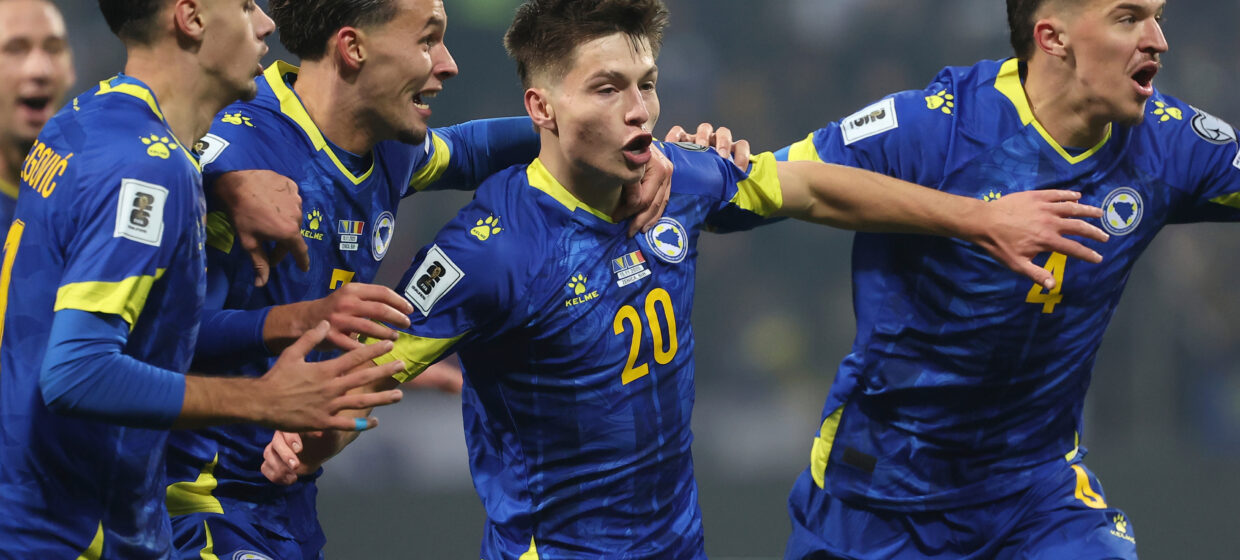
But when it comes to the players, consider Esmir Bajraktarević for a moment. He is twenty-one years old. He was born and raised in the United States, the son of Bosnian parents, growing up in Appleton, Wisconsin, before his football career took him to New England Revolution’s academy. He holds dual nationality. He chose Bosnia.
When Bosnia faced Italy in their final qualifying match, needing a result to reach the World Cup, it went to penalties. The last penalty, the one that sent them through, was taken by Bajraktarević and he dispatched it with aplomb. In that moment, on behalf of every Bosnian who had ever left and every one who had stayed, for a country his parents had been born in and a game he had learned in the country the song was about.
“Imagine how it looked when he scored his goal and immediately this song started playing in the stadium,” Jakubović said. “I mean, for me it was very emotional. I cannot imagine how it was for him.” Neither can I. And I grew up nowhere near Bosnia.
Bajraktarević has started every group stage game. He is one of the first names on the team-sheet and one of the players the United States will need a specific plan for on July 1st.
Bosnia are a vintage 4-4-2 side under Sergej Barbarez, compact and difficult to break down. They have also at times struggled to create, and were kept under 1.0 expected goals in all three group games, and they were out-possessed twice without it mattering particularly.
Their group stage read: a draw with Canada, a heavy loss to Switzerland, a 3-1 win over Qatar that got them through. The Switzerland result will interest Pochettino’s analysts but it should not be overread: Bosnia played that match knowing they needed goals and left themselves open chasing them. What is important is that despite their low expected goals, they have scored in every game. While the USMNT are favourites, Bosnia should not be underestimated.
If Bosnia have a talisman, it is their captain Edin Džeko. At 40-years-old, Džeko has 150 international caps, and scored against Qatar to extend his remarkable record of scoring for his nation in twenty consecutive calendar years going back to 2007. A Bosnian fan from Florida described Džeko to one journalist as “our Tom Brady.” That is about correct in terms of what Džeko means to Bosnian football, though Brady never had to navigate the Siege of Sarajevo as a child. Džeko’s presence gives this squad a weight that has nothing to do with tactics.
Beyond Džeko, Bosnia carry threats throughout the spine of the team. Ermedin Demirović offers a physical presence alongside him, Nikola Katić has dominated aerially throughout the tournament, while Sead Kolašinac and goalkeeper Nikola Vasilj provide the experience behind them.
The United States and Bosnia have met only three times, all in friendlies. The most memorable came in 2013, when Jozy Altidore scored a second-half hat-trick in a 4-3 American victory. Now we’re in the round-of-32 at the World Cup, none of those meetings tell us very much about what happens next.
Win here and the United States face the winner of Belgium versus Senegal in the round of sixteen in Seattle. Belgium are the obvious name on that side of the bracket but Senegal are capable and should not be assumed away. The bracket beyond that gets harder still.
Bosnia and Herzegovina arrive at Levi’s Stadium on July 1st with a song that belongs to everyone now, a forty-year-old living legend who has been scoring for his country since before some of his teammates were born, and a twenty-one-year-old American-Bosnian who scored the penalty that sent them here and will be lining up on the other side of the tunnel from the country that made him.
The United States are favorites, and they should be. They won Group D, they have beaten Australia and Paraguay, they have a team in form and Pochettino with a plan. They also have, for one night at least, the slightly complicated honor of being referenced within the famous Bosnian chant. Take me to America, indeed.
