MLS’ Next Great Export: Australian Starlet Lucas Herrington
June 22, 2026
WORDS
Joe Senior
There is a particular kind of confidence that cannot be coached. Colorado Rapids and Australia starlet, Lucas Herrington, seems to have been issued an unusually large supply of it at birth. He is 18-years-old, six-foot-four, and has spent the last six months treating some of the best footballers on the planet like mildly interesting colleagues rather than global celebrities. He marked Lionel Messi in front of more than 75,000 people, he marked Son Heung-min the following week and he marked Thomas Müller the week after that.
“I went on a three-game streak where I had Messi, then Son Heung-min, and then Müller,” Herrington told ESPN recently, with the tone of someone describing a busy fortnight at school rather than one of the more surreal stretches any teenage defender has faced in MLS history.
Herrington attended Anglican Church Grammar School in Brisbane, known colloquially as Churchie. One of Queensland’s oldest private schools, it has spent more than a century producing rugby players, rowers, lawyers, and politicians. Future Barcelona transfer targets have not traditionally been part of the alumni.
Football has a long history of coaches making extravagant predictions about teenagers, and a longer history of those predictions ageing terribly. In 1996, at a West Ham supporters’ forum, one fan informed Harry Redknapp that the club had allowed two better young players to leave while persisting with a midfielder named Frank Lampard. Redknapp responded by declaring Lampard would go “right to the very top,” that there would be “no comparison” between his career and those of the departed players, and that he would happily stake his own reputation on it. As predictions go, it aged reasonably well.
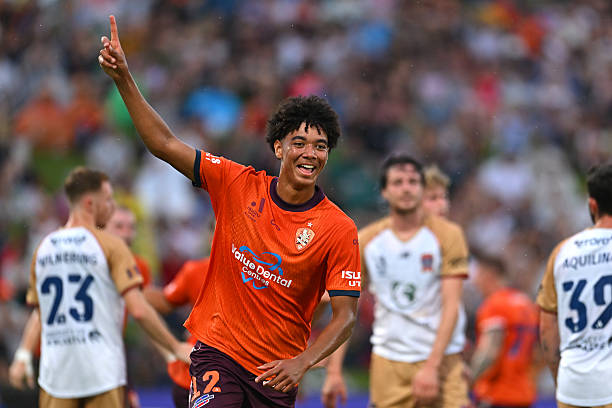
A-League side Brisbane Roar’s version arrived in September 2024. Herrington had not yet played a senior professional match when then-head coach Ruben Zadkovich told reporters that the teenager possessed “the highest ceiling of anyone” in Australian football and was “the best defender in Australian football right now.” It does not quite roll off the tongue like “straight to the very top,” but it does the job. 18 months later, Barcelona came calling.
Herrington played junior football for three different clubs around Brisbane before Roar’s academy got hold of him at thirteen. He debuted for the reserves at fifteen, made his senior debut in a 2-2 draw in December 2024, and scored his first goal the following month. Seventeen appearances and a string of performances that had grown coaches reaching for the word “ceiling” later, he was named the club’s Young Player of the Year and won a youth Asian title with the national U-20s.
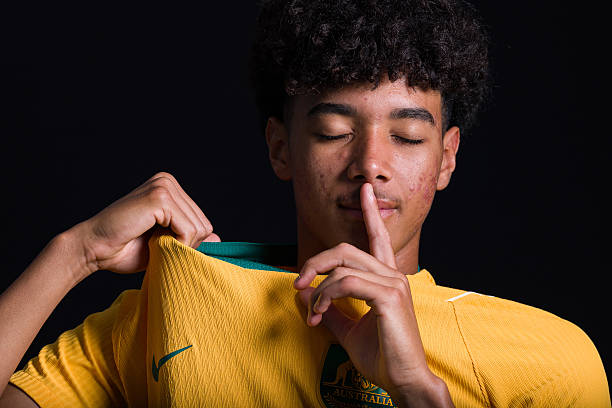
In January 2026, Colorado Rapids signed him, and the story properly accelerated. He started every single match of his rookie MLS season and became the youngest player in league history to play every available minute. Three months after his MLS debut, the Socceroos called to bring him into the national team fold, and he subsequently helped the side keep a clean sheet on his debut against Cameroon. “Cameroon is a good team, so to get a clean sheet and a win was pretty amazing,” he said. Two months after that, at 18-years-old, he was named in Australia’s World Cup squad.
Ask Herrington which moment of his short professional life has taught him the most, and he does not point to a goal or a clean sheet. He points to a defeat. Colorado’s thirtieth anniversary clash against Inter Miami drew more than 75,000 fans to Empower Field at Mile High, the second-highest single-game attendance in MLS history.
The Rapids pushed Miami all the way before losing 3-2, with Messi scoring twice, including the winner. Herrington’s numbers from that night tell you most of what you need to know about the level he was already playing at: an assist, 91% passing accuracy, six of nine accurate long balls, seven of nine duels won, and four clearances. His defense-splitting through ball helped drag Colorado back into the game before Messi did what Messi does. “We lost due to a typical Messi goal, which was tough,” Herrington said afterwards. “It was on me as well, which was a massive learning curve, just watching it back so many times. But it was special. He’s one of the best to play the game.”
He has a soft spot for Müller too, for reasons that have nothing to do with football and everything to do with family. “He’s a classy player, and my mom’s German, so I was rooting for him at the 2014 World Cup when Germany won,” Herrington said.
In the days before Australia’s World Cup opener, reports surfaced that Spanish giants Barcelona had lodged what one Australian outlet described as a “historic” bid for Herrington, reported at roughly €5 million. Colorado Rapids rejected the bid, not because the number was absurd, but because it was nowhere near absurd enough. The Rapids previously sold Canadian international defender Moise Bombito for over $5.8 million, and it’s fully expected this fee will need to be blown out of the water to have a chance at landing the Australian. This stance has not stopped Barcelona, Liverpool, and a host of others from joining the queue to find out.
I, along with other Australian football fans, am still trying to soak it all in. An MLS club turned down Barcelona because the offer was too small. If a deal eventually lands anywhere near the CIES Football Observatory valuation of $20 million, Herrington could well become the most expensive Australian player in history, and one of the most lucrative player sales in Major League Soccer history.
Herrington’s own response has been exactly what you would expect from someone who can watch Messi score the winner against him and still call it special. “I’m not really thinking too far in the future,” he said when asked about the transfer speculation. “It’s just Colorado, and now focusing on the World Cup. We’ll see what happens after that.”
What gets lost in the transfer noise is that Herrington moved to the other side of the world alone at eighteen, and it was not easy. “It was tough. I had to do everything by myself, cook, clean, look after myself,” he admitted. “But I have enjoyed it.” His centre-back partner at Colorado, the former Arsenal defender Rob Holding, has become an important steadying presence. “He helps so much with his positioning, communication, and advice, and he’s been great to play alongside.”
There is something worth sitting with in that. A teenager who marks Messi for a living and barely blinks was also, at the same time, learning to cook his own dinner in a country he had never lived in before. Composure on the pitch and homesickness off it are not contradictions. They are usually the same story told from two different rooms. Asked whether the big stage rattles him, his answer suggests it genuinely does not. “I think it’s just believing and sticking with the process of the team,” he said. “I obviously work a lot preparing for these games, so it’s just trusting what the coaches have set out for us.”
Herrington will keep playing for Australia at this World Cup, with every touch now being watched by recruitment staff who, a year ago, would not have recognised his name. He will leave Colorado Rapids eventually, almost certainly for Europe, almost certainly for a fee that rewrites the record books for Australian football and quietly rewards an MLS club and an Australian academy system that found him before anyone else bothered to look.
Whether the move happens this summer or the next, and wherever it ends up taking him, the story underneath the transfer fee is a more interesting one anyway: a kid from a Brisbane rugby school who had to learn to cook for himself in Colorado, who watches his own mistakes back on video even when the world is busy celebrating the goal that beat him, and who is rooting, in some quiet corner of all this, for his mother’s old team as much as anything else.

Contributors
Joe Senior
TAGS