O Jogo Bonito in the United States: Brazil and MLS
August 24, 2026
WORDS
Joe Senior
Ideas over who originally coined the Portuguese phrase ‘O Jogo Bonito’, or ‘The Beautiful Game’, are varied, and I will not claim to have an answer. But I think most people can agree on who made it famous.
Pelé indisputably exists as the pinnacle of both the beautiful game and the iconic Ginga style that has become synonymous with Brazilian Football. From playing street football in Bauru, to Santos at fifteen, to lifting the World Cup at 17, Pelé had a way of making the game very beautiful indeed.
Brazil have not struggled to recreate the archetype. Ronaldo Nazário, Ronaldinho, and Neymar have each taken their turn setting the football world alight. The current Brazilian squad continued to showcase their technical ability at the recent World Cup, despite eventually going out 2-1 defeat to Norway in the round of 16.
All of which is to say: Brazil is a nation with exceptional football pedigree. And lately, an increasing amount of its vibrant players are ending up in the United States.
The data is striking. As of the 2026 season, Brazil is the second most represented foreign nationality in Major League Soccer, with 36 players currently active across the 30 clubs, sitting behind only Canada. At the start of last season MLS featured 29 Brazilian players. That figure has already been surpassed, and the summer window is not closed yet.
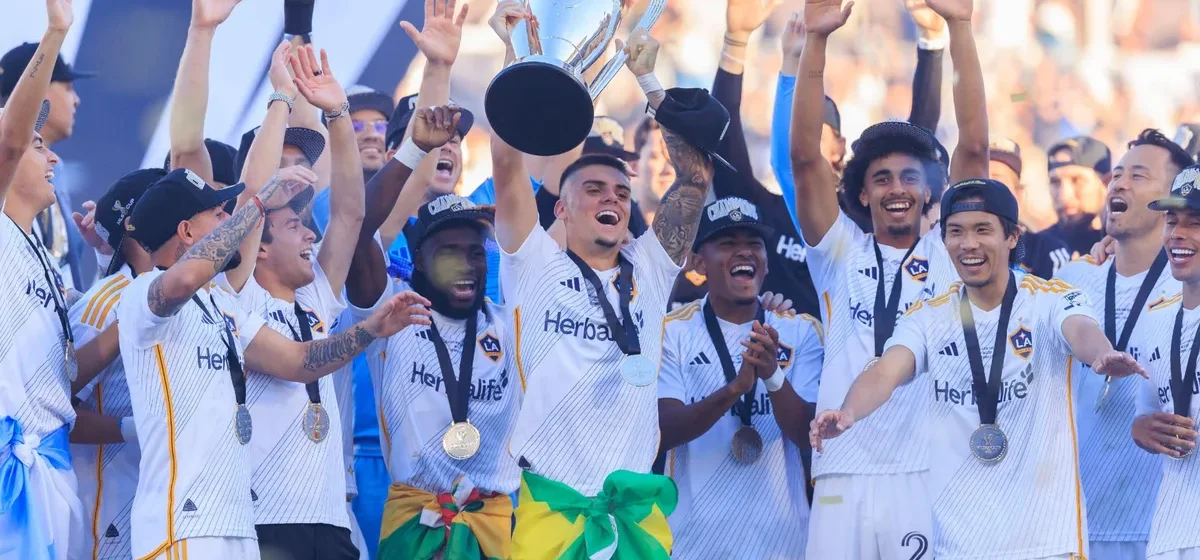
Look at the top-25 outgoing MLS transfers of all time and Brazil appears at both ends of the pipeline. Two of the five largest outgoing sales in MLS history went to Brazilian clubs. Gabriel Pec left LA Galaxy for Cruzeiro just weeks ago for $12 million.
A peek at the incoming transfers shows you a rapid increase in the number of Brazilian players joining MLS. From 2023/24, the MLS went from 6 Brazilian arrivals, to eight in 2024/25, to 13 in 2025/26. Only days ago, André Luiz joined Sporting Kansas City for a reported $18 million up front, with the deal potentially rising to $22 million. The move made him the third most expensive transfer in MLS history, and the most expensive Brazilian. The pattern isn’t just a coincidence.
Houston Dynamo are one of those who have bought into this relationship, showcasing among the highest concentrations of Brazilian players of any club in the league, with several Brazilians featuring across their squad including Felipe Andrade, Lucas Halter, Antonio Carlos, Artur, and Guilherme Augusto. Another five appear in the club’s MLS Next Pro team, Dynamo 2.
I have always had a soft spot for clubs that inexplicably contain a huge concentration of one nationality. There is something beautifully chaotic about it, a kind of accident that becomes its own identity. My absolute favorite example being Wolverhampton Wanderers having ten first team players, and a coach who were all Portuguese a few years ago. Trust me, it only gets funnier if you have ever been to Wolverhampton.
Houston’s Brazilian colony is not quite at that level of commitment, but the intent is clear. The club has developed active scouting relationships with Brazilian clubs, most recently signing Lucas Halter from Botafogo on a permanent deal. When you know where to look, the pipeline is visible.
The pathway for Brazilian talent into MLS has traditionally followed a familiar route: youth football in Brazil, a move to Europe, and then MLS as a second or third career destination. That model is how Evander arrived at Portland Timbers after leaving FC Midtjylland in Denmark. It is also how he eventually ended up at FC Cincinnati, who paid a record $12 million guaranteed to bring him to the Eastern Conference in 2025. He is currently worth $18.5 million, making him the most valuable Brazilian in the league and one of its most valuable players full stop. He’s not just ornamental either. He currently sits top of the league for assists, and behind only Lionel Messi and Petar Musa in the golden boot race.
The more recent and more interesting development is the reverse flow. MLS clubs are no longer simply receiving Brazilian talent that has already been filtered through European football. They are developing players and selling them back to Brazil at a profit. Gabriel Pec arrived at LA Galaxy from Vasco da Gama for around $10.5 million in 2023. He became an MLS All-Star.
Multiple Brazilian clubs competed to sign him. Cruzeiro won. He left for $12 million, leaving LA Galaxy with a modest but real profit and a development story to tell European clubs watching from across the Atlantic. If anythings going to help break the retirement league allegations, it will be that kind of development potential.
The really interesting part is that the relationship between the MLS and Brazil is no longer being built solely by clubs. Earlier this year a delegation from the CBF, the governing body of Brazilian football, flew to the United States. They were not there to watch a game or scout a player. They were there to study MLS. Its financial model, its governance, its structure. They went home looking at what they had seen as potential lessons for the future of Brazilian football. Sure, the impending World Cup offered a convenient reason to visit, but this seems a pretty strong case for a genuine relationship being built between the leagues.
Multi-club ownership groups have existed for a while, and groups such as Red Bull and City Football Group have invested in both MLS and Brazilian clubs. Red Bull own both New York Red Bulls and Red Bull Bragantino in Brazil. City Football Group own both New York City FC and Bahia. These are only some of the leagues these groups are invested in, but regardless it is further evidence of how the emerging relationship.
The Brazilian presence in MLS is not entirely new, of course. Kaká, the 2007 Ballon d’Or winner and World Cup champion, joined Orlando City SC in 2014 as the club’s first ever Designated Player, spent three seasons making the All-Star game each year, and scored the club’s first ever MLS goal. Kaká came and left and was remembered as one of the great individual stories the league has told. What we’re seeing now is the seed that Pelé and Kaká planted coming to fruition.
Pelé came to New York in 1975 and spent three seasons trying to convince America that football was worth paying attention to. Kaká came to Orlando in 2015 and showed again that a genuine superstar could arrive and not regret it. What is happening now is neither of those things, but something quieter and hopefully more durable. 36 Brazilian players active across thirty clubs. A CBF delegation studying the American model. Brazilian clubs buying MLS players back. Ownership groups spanning both countries. Now André Luiz signing a five year contract in Kansas City, and smashing into the top three most expensive signings in league history.
O jogo bonito has been making its way to the United States for fifty years. It has finally decided to stay.
