The Passing of the Torch: Tim Ream and the USMNT
October 5, 2026
WORDS
Joe Senior
Tim Ream would like to clarify something.
He is retiring from the United States men’s national team. He is not, as far as he is concerned, retiring from football. Even the word “retirement” seems to make him a little uncomfortable, which is maybe why Yahoo Sports reporter Steve Goff was dancing around the question in St. Louis last week. Eventually, Ream had enough.
“Am I retiring from the national team is what you’re asking? Let’s just shoot it straight here.” Ream admitted they’d played around with the word ‘recognition’ instead, but that in essence, yes, “it is retirement.”
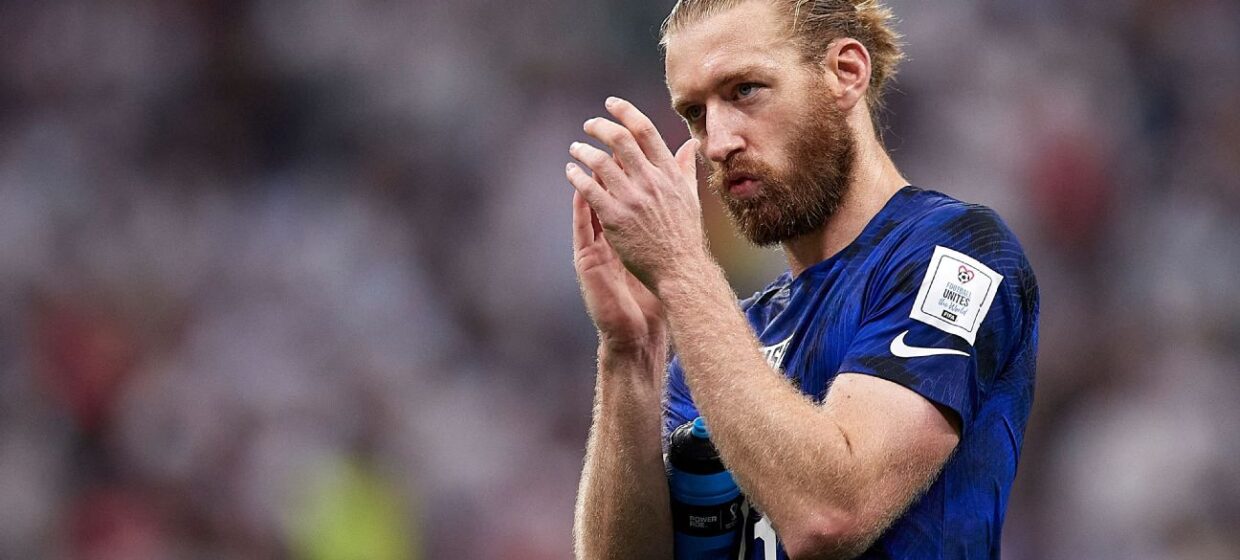
U.S. Soccer had planned a celebration for the hometown hero before the United States played Chile. There was a framed jersey with 86 on the back, a crowd at Energizer Park and, presumably, the expectation that Tim Ream would stand there and graciously accept a little fuss about himself.
This was never really going to be his thing. “It wasn’t my idea,” he admitted later. “I’m more of just a guy who just thought I was just doing my job, playing my role.” That might be the most Tim Ream sentence imaginable.
For 16 years, he played his role for the USMNT. He made his debut in 2010, became the defender managers trusted, spent nine seasons at Fulham, and somehow kept extending an international career that had already outlived the expectations most players would have had for it.
He finished with 86 caps, 26 of them as captain, two World Cups and enough different USMNT generations to make a family tree look uncomplicated.
Only DaMarcus Beasley has a longer career among USMNT field players. Mind-bogglingly, 60 of Ream’s 86 caps came after he turned 30. In an age when football increasingly seems designed to make defenders run faster, Ream’s great trick was becoming more valuable as the years accumulated.
His first World Cup came in Qatar, where he played every minute of all four American matches and helped the United States keep two clean sheets. Getting to another one was then a personal goal. Ream wasn’t certain he would make it when he left the 2022 tournament, but he did exactly what he set out to do.
He made the 2026 squad, but not only did he make it, Pochettino made him captain.
Ream said the captaincy had never really been part of the dream. Playing professionally had been the dream. Playing for his country had been the dream. Captaining the United States at a home World Cup was apparently something his imagination hadn’t even considered. “It’s an honor,” he said. “The dream didn’t include being a captain. That’s a little bit of a bonus.”
There is something fitting about that. Ream spent much of his international career accumulating responsibility without ever seeming particularly interested in accumulating status.
And when he did finally become captain, his instinct was not to cling to it. He wanted to help the next player get it. “The biggest thing that I wanted to do as I started to get the captain’s armband more and more is how can I help these guys become the next captain?”
That sentence alone shows the quality and size of character that will be missing from the next USMNT. The armband is already spoken for. Tyler Adams has taken over as captain for the new cycle. The harder thing to replace is the player who could help everyone else feel like they belonged there.
The USMNT has plenty of talent coming through, and Ream himself seems fascinated by it. He mentioned the same thing he noticed when the current generation first arrived: the confidence. The swagger. The slightly alarming feeling that teenagers have somehow decided they are already quite good at football.
“They have a ridiculous amount of confidence,” Ream said. “It borders on being cocky.” He did not sound particularly worried about it. He actually seemed to like it. “There’s a little bit of swagger,” he said. “You have to have that belief in yourself.” What Ream doesn’t explicitly say here is that confidence is one thing. Confidence backed by evidence is another.
As our own Adam Booker wrote in Howler last week, American soccer has spent decades getting very excited about the next great teenager before having much idea what that teenager could actually do. The word “prospect” appeared a lot. A few clips would circulate, a European club would appear in the story, and everyone was discussing the future tense.
This group feels a little different. On Ream’s own night, Julian Hall, 18, headed in his second goal in as many caps. No player in USMNT history has done that younger. Then Mathis Albert, 17, came on for him in the 71st minute and scored in stoppage time. At 17 years and 131 days, he is the youngest goalscorer the program has ever had.
Ream had already felt his age that week. The night before, on his way to a Q&A, a text arrived: he was a senior at Saint Louis University when Cavan Sullivan was born.
“Ah geez,” he said. Sullivan, it turns out, is only four years older than Ream’s oldest. He had said before that he wouldn’t retire from the national team until he retired from the game. Then the kids got younger. “The kids are getting younger and younger,” he said, “and I don’t mean my own kids.”
It wasn’t a snap call, either, he told Pochettino before this camp. Physically, he says, he still feels good. The question is whether the long hours before training still match the time it takes to recover afterwards. He has been giving himself what he calls a “runway”. He has also reflected on “the time that your loved ones don’t get with you.”
While his departure leaves a gaping hole in the leadership group, it also leaves the USMNT with a gap at centre-back. Chris Richards, 26, has spent years alongside Ream. He headed the winner against Chile on the night. Neil Pierre is 18, 6’5″ and plays for the Philadelphia Union. He is already being tipped as the long-term successor. Nobody replaces 86 caps. Somebody still has to be the defender everyone else trusts.
But Ream is not leaving the game, at least not yet. He returned to MLS with Charlotte FC in 2024 after nine seasons at Fulham. He has not decided when the rest of his playing career will finish. “I haven’t made a decision,” he said. “I’m not entirely sure what’s going to happen.”
Charlotte were fourth in the East at the time. Ream wants third or second, a playoff run and a trophy. Nothing will be said “until after the last ball is kicked.”
But why was St. Louis the right place to honor a departing legend? Ream grew up there, played his youth football there and went to Saint Louis University, leaving in 2010 when the New York Red Bulls drafted him. 16 years later, he came home with 86 caps, two World Cups under his belt and a captain’s armband from one on home soil.
“Where did the dream start?” he asked. “It started here in this city.” The dream hasn’t ended, he said, just the playing for the national team.
Asked what he was proudest of, he wouldn’t choose a game, a World Cup or a manager. “I would say the whole thing.” The last four years, he added, were the most enjoyable he has had with a national team. Even now, he can’t quite say the word.
Asked about the rest of his career, he said he’s much closer to being finished than he was six months ago. Then he caught himself. “There I go again: closer to, not saying retirement, but finishing.” He is finished with the USMNT, but as for retirement, Ream would like to reserve the right to keep working on the wording.
