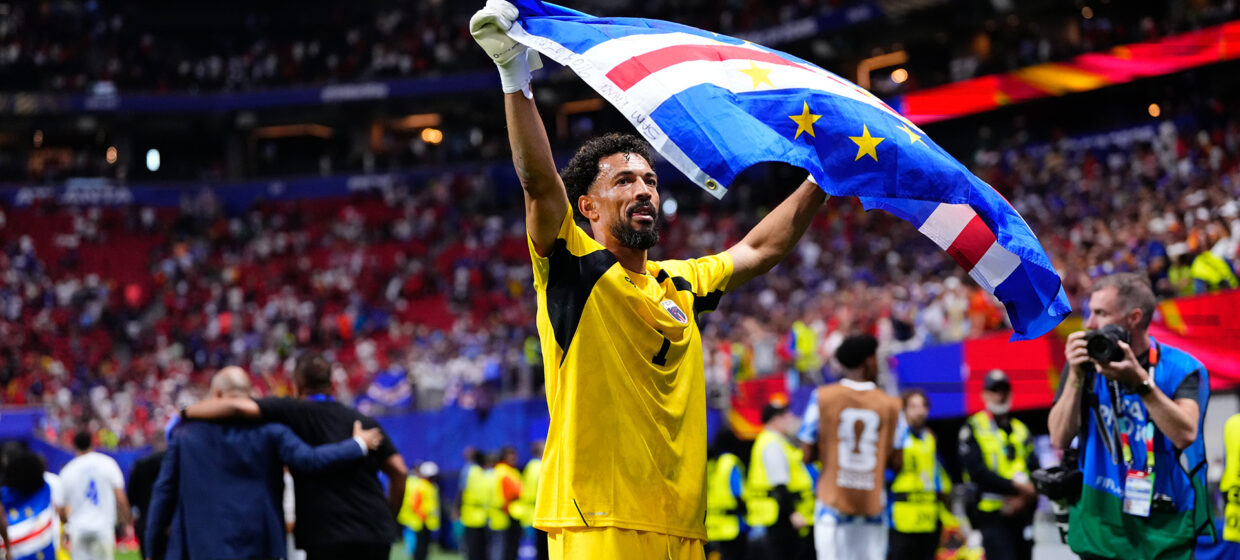
Cabo Verde. That is the headline.
Amidst everything the 2026 World Cup on American soil has already produced, a tournament classic occurred in Miami last week, played between the reigning champions Argentina and a team from an island nation of half a million people. Argentina won 3-2 in extra time, but ask anyone who watched it and they will tell you the same thing: Cabo Verde won.
Before we get into the match, let me get some cliches out of my system. If we only take away one thing from their stunning run, it is the humbling reminder that nothing is promised. Victory has to be earned. In the words of Tim Notke and Kevin Durant, ‘Hard work beats talent when talent doesn’t work hard’. It is not about the size of the dog in the fight, it is about the size of the fight in the dog. I could keep going but I’m sure you get the gist.
Cabo Verde have made each and every team they’ve faced earn it. For a country only slightly larger than Rhode Island, their performances at this tournament have been, simply, unbelievable.
Cabo Verde entered this World Cup as the lowest-ranked nation ever to reach the knockout stage. Their group stage was a masterclass in defensive organisation, collective belief, and the stubborn refusal to be beaten.
They held Spain, the European champions and one of the tournament favourites, to a 0-0 draw in their opening match. Vozinha, their 40-year-old goalkeeper, made seven saves and became a social media phenomenon in the subsequent hours and days. They then drew with Uruguay, drew with Saudi Arabia, and went through as one of the best third-place teams in the tournament. That is a group stage unbeaten run against Spain, Uruguay, and Saudi Arabia, by a nation whose previous greatest tournament achievement was reaching the Africa Cup of Nations quarter-finals.
The 48-team format has its critics, and they are not entirely wrong. The group stage can feel diluted, and the logic of third-place teams advancing is impure at best. From a player safety perspective, it also creates an extra 40 games compared to the previous format. The 48-team format not only dilutes the quality of teams but also dilutes the quality of performance a player coming off the back of a full season can provide.
If you want a single exhibit for the defense of the 48-team format, Cabo Verde’s journey to the round-of-32 is Exhibit A. Without the expanded format, these players, this story, this goalkeeper, go home after the group stage qualifiers and nobody outside of African football ever hears their names. With it, the whole world can’t stop speaking about them.
The Man Whose Name Everyone Now Knows
Before the tournament started, Vozinha had 50,000 Instagram followers. At the time of writing, he has 27.5 million.
His full name is Josimar José Évora Dias. He is forty years old. He has spent nearly two decades bouncing between clubs in Cape Verde, Angola, Moldova, Portugal, Cyprus, and Slovakia, accumulating ninety-four international caps and precisely zero global recognition. He was a free agent when this World Cup began, having just left Chaves in Portugal’s second division, and he is now, incontestably, one of the most famous goalkeepers on earth.
Against Spain he became the oldest goalkeeper ever to keep a clean sheet in a World Cup debut, against Argentina he made eight saves, denied Messi from a free kick in the 73rd minute with a stunning stop, and kept his team in a match they had no business being in for 120 minutes.
His story almost began under another name. In 1986, his father tried to register him as Valdano, after Argentina’s World Cup-winning forward Jorge Valdano. Cape Verdean registry rules at the time did not allow foreign names, so the request was refused. Instead, he was named after Brazil full-back Josimar, another star of that same tournament.
I think the namesake of a defender is more fitting, although I’m sure his father didn’t expect him to use his hands. Thirty years later, his son stood between the posts for his country’s first ever World Cup and fought to deny Lionel Messi. How can you not be romantic about the beautiful game?
The Man Who Got His Call-up on LinkedIn
Vozinha is not even the most unlikely story on this team. Roberto “Pico” Lopes is a 33-year-old central defender who was born in Dublin, to an Irish mother and a Cape Verdean father, and plays for Shamrock Rovers in the League of Ireland. In 2018, the Cape Verde national team coach Rui Águas discovered Lopes had a Cape Verdean father and sent him a message on LinkedIn, of all places, asking if he would like to represent the country. Lopes did not speak Portuguese. He read the message, assumed it was spam, and ignored it.
Nine months later, Águas followed up in English. Lopes, realising his mistake, apologised profusely and said he would love to play. A few weeks later, the paperwork was complete and Pico Lopes was playing for Cape Verde in a friendly against Togo. A LinkedIn message that almost went unread, written in a language the recipient did not speak, sent to a defender from Dublin, eventually produced a center-back who played in a round-of-32 match at the World Cup.
Cape Verde’s federation had long struggled to attract players with multiple eligible nationalities, many of whom, like Ronaldo, Nani, and Semedo chose to play for Portugal instead. So they went on LinkedIn, and found Pico Lopes in the League of Ireland. Most LinkedIn messages lead to sales pitches or recruiter spam. Apparently not always. I’ll be watching mine more closely.
That Match
Argentina scored first, because of course they did. Messi, in the first half, with a goal that can only be described as Messi-esque. His touch and finish were good enough to make me feel like I disrespect the sport every time I kick a ball. I’ll also take a moment to acknowledge the incredible pass of Manchester United centre-back Lisandro Martinez to set up the goal.
Cabo Verde equalized. Just before the hour mark, Deroy Duarte squeezed the ball into the far corner, and a small contingent of passionate Cabo Verde supporters erupted in the Miami Stadium. Argentina scored again in extra time, Martinez making a statement by lashing in at the near post to make it 2-1. This, it seemed, was where the fairytale ended. 90 minutes, a draw, an equalizer, and then the champions reasserting the natural order.
And then Sidny Cabral scored what may be the goal of the tournament. A left back, cutting inside, curling a right-footed shot into the top corner from outside the area, against Argentina, in extra time at a World Cup, while some of the best players on the planet could watch as the nestled into the pocket behind Emiliano Martínez. If anyone reading this doesn’t know what I’m talking about, do yourself a favor and go find it.
Cabral vaulted the hoardings and went looking for his girlfriend. His teammates laughed and embraced. Once again, the tiny pocket of Cabo Verde supporters in the stands lost their minds. Eight minutes later, a Diney Borges own goal from a Romero header deflected in off the post, and Argentina were through. Fairytale over this time. But not really over. Not in the way that matters.
I think the legendary Thierry Henry said it best. “The story is, was, and always will be, Cabo Verde,” the former Arsenal and Barcelona forward said on Fox. His fellow panelist and legendary forward Zlatan Ibrahimović reiterated the sentiment. The world football community, which largely ignored Cabo Verde’s existence before June 15th, spent the days after this match trying to articulate why watching them felt so good.
The answer is straightforward. Football at its best is not about money or squads or transfer budgets or FIFA rankings, it is about a goalkeeper who spent twenty years in obscurity and then made eight saves against Argentina at 40-years-old. It is about a defender from Dublin who nearly ignored a LinkedIn message and ended up at a World Cup. It is about Sidny Cabral, curling a shot into the top corner in extra time and sprinting toward the stands while Messi stared at the ground.
A whole generation of football fans now knows Vozinha’s name, even if they cannot point to Cabo Verde on a map. They will look it up. An island nation of half a million people, roughly the size of Rhode Island, just taught the world champions something they apparently needed to be reminded of.
The tournament goes on. The Blue Sharks go home. But this certainly feels more like a beginning than an ending. Until next time Cabo Verde. Thank you.
